

This post is in response to Satya Nadella’s post: “A frontier without an ecosystem is not stable” on June 14, 2026.
Did Satya Nadella just challenge or empower HR?
"… human capital does not become less valuable as token capital grows. It only becomes more valuable! I believe human agency will be the driver of token capital growth." ~ Satya Nadella.
Satya Nadella wrote this a few days ago in a post about the economics of AI, and my guess is he wasn't writing it for HR leaders. He was most likely thinking about CEOs and investors. But I would propose it's the best AI transformation invitation HR leaders have been handed in years, maybe ever, and it's worth talking through what to do with it.
HR leaders have probably already heard some version of "HR should lead AI transformation" a dozen times this year. Design architect. Capability steward. Adoption catalyst. The language is everywhere right now, and most of it is true, and most of it stays vague enough to nod along with without anyone actually changing what they do on Monday.
Nadella put a sharper edge on what that human side actually does later in the same post: "without human direction, you have compute running in circles." That's the part of the equation that matters here. AI doesn't just need a champion in HR; it needs HR to do what HR is designed to do, empower people by working directly with the business, to turn humanᴬᴵ learning into practical application, the one piece of the puzzle nobody else in the building can build.
It's worth being direct about why that responsibility lands on HR and not on IT. IT's entire discipline is built to make systems behave predictably: uptime, security, scale, control. The work Nadella is describing, judgment, trust, learning, behavior that has to adapt without breaking, is the opposite kind of work. It's not that IT is too busy to do it. It's that the skillset doesn't transfer. HR already owns the parts of the organization that do: development, performance, culture, change. The opportunity in front of HR leaders isn't an invitation to help; I believe it's more of a net new functional muscle that needs to be organically developed in a uniquely HR way with employees at the center.
So what does building this AI adaptation muscle actually look like?
First, claim the responsibility to own the adaptation cycle. Nadella's argument rests on companies building what he calls a learning loop, where human judgment and AI capability compound together over time instead of just sitting next to each other. He's right about why it matters and quiet about how it actually works. The bridge over that gap is HR's to build. Real adaptation has at least three parts: teaching people what a given technology can and can't do, redesigning how the actual workflow and incentives around the technology need to change, and giving people structured reps at the judgment calls, when to trust an AI output, when to override it, when to ignore it entirely. Most companies are funding the first part. Almost nobody's funding the other two, and nobody owns designing them on purpose. HR can.
Second, treat earned intuition as IP. Companies already protect their models and data like assets. Most don't protect the thing Nadella says matters most: the judgment a fifteen-year employee makes without thinking twice, the read on a client that took years to build, the instinct for which exception to grant. That knowledge walks out the door every time someone leaves and gets rebuilt from scratch by whoever's left. HR is already sitting on the infrastructure for capturing it, performance systems, knowledge transfer, succession planning. Most companies just aren't pointing it at this problem yet.
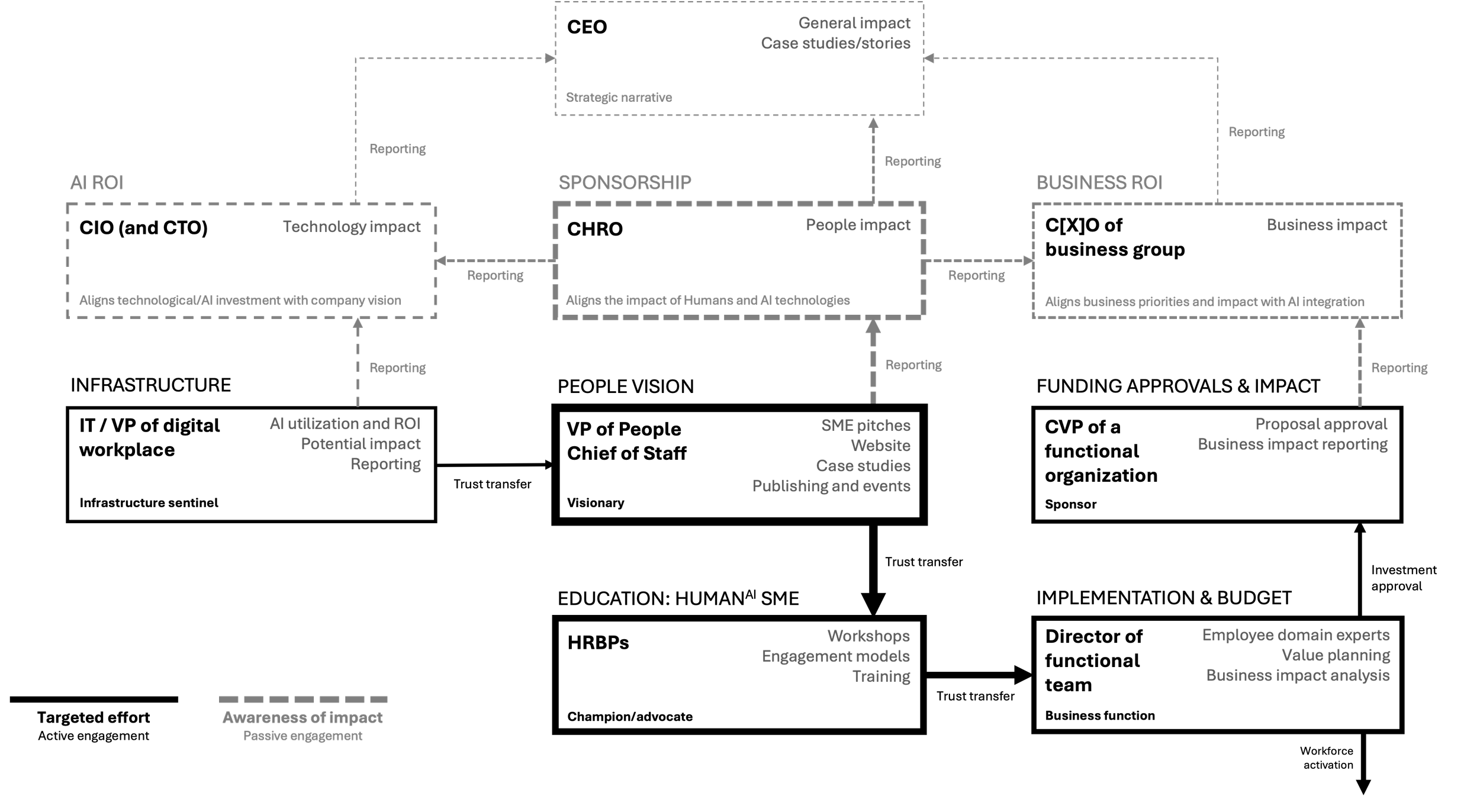
Third, AI activation scales through HR business partners. HRBPs are already embedded with sales, finance, and ops, with the standing relationships and day-to-day access nobody else in the building has. They already have a one-to-many job function. Their job has to shift from interpreting policy to building alongside the team: helping design how humans and agents work together inside a real workflow, building it with them, then training the people who'll run it on the judgment calls that actually matter, when to trust the output, when to override it, when to shut it off. That's so much more than a workshop, although that's a good place to start. It's a cycle of adaptation, run person by person, team by team. AI activation doesn't scale through a company-wide rollout. It scales through waves of people getting measurably better at working with their agents, and then influencing others. An individual or team cycle of adaptation scales into a company-wide cycle of influence.
Nadella used his platform to make an economic case for why human capital matters more, not less, as AI scales. He didn't say who's supposed to build it. I don't think that is an oversight as much as it's an open question, maybe even a challenge, and right now, I believe HR is the only function in the building with both the mandate and the muscle to answer it.
Supporting diagram of how trust transfers through an organization: