


Humanᴬᴵ
Humanity elevated by intelligence
Artificial intelligence is often discussed as a technology transformation, but technology alone has never transformed organizations.
Throughout history, transformative technologies have changed the environments in which people operate, and as environments change, behaviors, culture, and performance evolve with them. Artificial intelligence is no different. While much of today's conversation focuses on models, infrastructure, governance, and automation, the larger opportunity lies elsewhere. The real opportunity is understanding how abundant intelligence can expand human capability and what organizations must do to unlock that potential.
This is the idea behind humanᴬᴵ.
Represented as human to the power of AI, humanᴬᴵ is both a philosophy and a design principle. It places people at the center and positions artificial intelligence as an amplifier of human capability, creativity, agency, contribution, and innovation. At its core is a simple belief: artificial intelligence should elevate humanity, not replace it. In a world where intelligence is becoming increasingly abundant, the greatest opportunity is not to automate work, but to elevate what it means to be human.
The concept emerged from observing a pattern that is becoming increasingly common across organizations. Most AI initiatives begin with experimentation as individuals and teams explore new tools and discover new possibilities. As adoption grows, organizations shift their attention toward governance, security, infrastructure, platform strategy, and enterprise readiness. This stage, which Devonport describes as Wave 2, focuses on building the foundations required to support AI at scale. The work is largely led by IT because the challenge is fundamentally technical: making intelligence available, accessible, secure, and trusted across the organization.
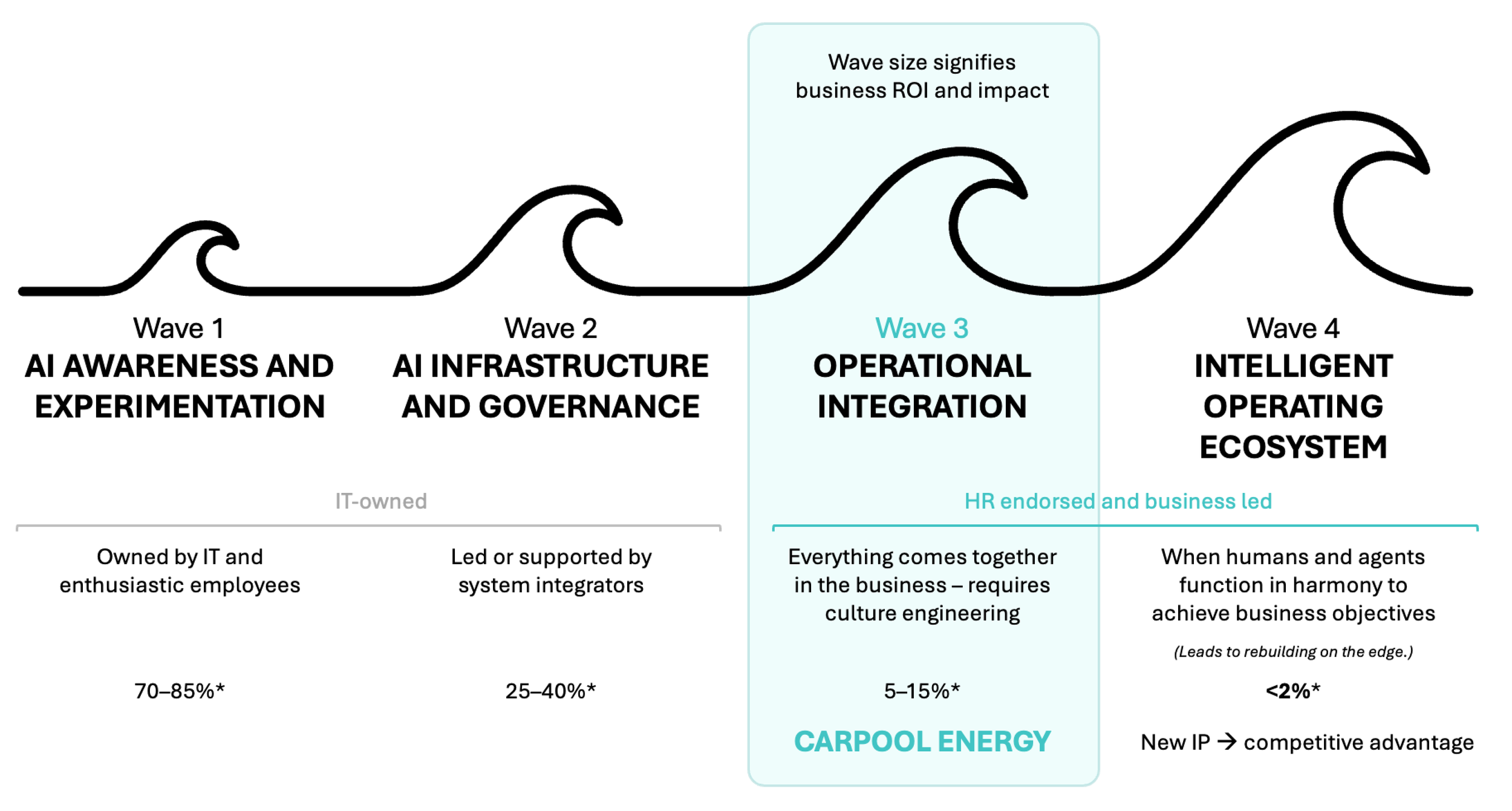
Yet many organizations discover that once the technology is in place, the challenge changes. Access to intelligence alone does not create transformation. The models work. The platforms are available. The infrastructure is established. What determines success now is whether people can effectively integrate intelligence into the way they work, learn, collaborate, solve problems, and create value. This next stage, Wave 3, shifts the focus from technology enablement to human enablement. Adoption, engagement, capability development, leadership alignment, behavior change, and culture become the primary determinants of success.
This transition is where humanᴬᴵ becomes essential.
Wave 2 and Wave 3 require different capabilities and different leadership. If Wave 2 is about building the intelligence infrastructure, Wave 3 is about building the human infrastructure that allows intelligence to flourish. Organizations that successfully navigate this transition recognize that AI transformation is not simply about deploying new capabilities. It is about helping people develop new capabilities. The focus moves from systems and tools to learning, trust, experimentation, community, and organizational design. Technology makes intelligence available. People determine whether that intelligence creates value.
This is why humanᴬᴵ sits at the intersection of HR and IT.
Historically, technology initiatives have been owned by technology functions, and rightly so. Technology teams are responsible for the platforms, governance, security, and infrastructure that make enterprise transformation possible. Much of today's investment in AI remains concentrated in these areas because organizations are still building the foundations required to operate intelligently at scale.
However, infrastructure alone does not create business impact. As organizations enter Wave 3, HR and business leaders move to the forefront because they influence the conditions that shape adoption. Learning systems, capability development, leadership practices, organizational design, incentives, community building, and culture become just as important as the technology itself. If IT is responsible for building the intelligence infrastructure that powers Wave 2, HR and business leaders become responsible for building the human infrastructure that powers Wave 3. One makes intelligence available. The other makes intelligence valuable.
Viewed through this lens, humanᴬᴵ becomes an equation for organizational transformation.
The notation is intentional. In mathematics, an exponent changes the scale of an outcome. Humanᴬᴵ applies the same principle to organizations. Artificial intelligence is not merely another tool added to existing work. It is a force multiplier capable of expanding what people can learn, create, contribute, and accomplish. The objective is not to reduce the importance of people. The objective is to increase their capacity. AI can help individuals develop expertise faster, solve more complex problems, make better decisions, collaborate more effectively, and generate new forms of value. When introduced into the right environment, intelligence does not replace human contribution. It amplifies it.
This idea becomes even more important as organizations move toward what Devonport describes as an agentic economy. An agentic economy is a system in which humans and intelligent agents interact with purpose, exchange information, make decisions, and generate value within a shared environment. As intelligent agents become embedded throughout organizations, work increasingly shifts from being performed solely by people to being performed by ecosystems of coordinated intelligence. People, agents, systems, workflows, and organizational knowledge become interconnected participants in value creation. In these environments, competitive advantage is no longer determined by access to intelligence. Intelligence is becoming increasingly abundant. Competitive advantage is determined by an organization's ability to coordinate intelligence, develop people, and continuously adapt.
Humanᴬᴵ provides the philosophy that guides this evolution. It encourages organizations to view AI adoption as an experiential journey rather than a technology deployment. It prioritizes learning through experimentation, trust through participation, capability through practice, and innovation through collaboration. People rarely become confident because they attended a training session. They become confident because they have opportunities to experiment, succeed, fail, learn, and grow within supportive environments. Adoption accelerates when people experience AI as something that helps them become more capable rather than something that threatens their relevance.
Ultimately, humanᴬᴵ is a framework for unlocking people potential in the age of abundant intelligence. It challenges organizations to ask a different question. Instead of focusing exclusively on how much work can be automated, it asks how much human potential can be activated. Instead of viewing technology as the destination, it views technology as the catalyst. Instead of optimizing solely for efficiency, it seeks to create environments where people can continuously expand their capabilities, contribution, and impact.
The significance of Wave 3 cannot be overstated. Most organizations already understand the importance of technology transformation. Far fewer understand the importance of human transformation. Yet as intelligence becomes increasingly abundant, competitive advantage will be determined less by access to AI and more by an organization's ability to help people adopt, apply, and amplify it. The organizations that thrive will not be those that simply deploy the most advanced technology. They will be the organizations that most effectively combine human potential with artificial intelligence, creating operating ecosystems where people and intelligence amplify one another in pursuit of shared outcomes.
The first stages of AI adoption are about making intelligence available. The next stage is about making intelligence useful. Humanᴬᴵ exists to help organizations cross that bridge.
The humanᴬᴵ equations:
Hᴬᴵ = I x E x A and Hᴬᴵ = f(I,E,A)
Let’s dig into how we get to this equation…
Let’s start with the research supporting an interesting initial equation:
Humanᴬᴵ = Intelligence × Environment × Adaptation (Hᴬᴵ=I×E×A)
Where:
I = intelligence abundance (AI, agents, knowledge, automation) - intelligence provides capability.
E = environment design (infrastructure, systems, culture, incentives) - environments determine how capability is expressed.
A = human adaptation (skills, behaviors, judgment, creativity, leadership) - adaptation determines whether capability becomes transformation.
When all three compound together, people potential expands, organizations evolve, and new forms of work become possible. This aligns almost perfectly with the nine domains:
Technology changes environments.
Environments shape people.
Culture evolves when environments change.
Technology elevates the human condition.
AI expands capability.
Potential exceeds performance.
Intelligence abundance changes responsibility.
Agents become cultural participants.
Organizations rebuild on the edge.
Note, the equation says: Intelligence alone does not create Humanᴬᴵ. Humanᴬᴵ emerges when abundant intelligence is combined with intentionally designed environments and human adaptation.
Mapping to the waves
The waves then become a progression through the equation.
Wave 1: Discover AI
Hᴬᴵ=I
Focus: Learning, experimentation, and awareness.
Wave 2: Build the infrastructure
Hᴬᴵ=I×E
Focus: Platforms, governance, knowledge systems, agent foundations, operating ecosystems.
Alignment: research domains 1-3.
Wave 3: Improve existing systems
Hᴬᴵ=I×E×A
Focus: Workflow redesign, capability expansion, human augmentation, community activation, trust transfer
Alignment: research domains 4–8.
Wave 4: Rebuild on the edge
Instead of optimizing the existing equation:
Hᴬᴵ=I×E×A move to Hᴬᴵ=f(I,E,A)
Or more simply: New Organizations = Humanᴬᴵ
Aligned to research domain 9.
This is where organizations move from AI adoption to AI-native design. The entire research sequence can be reduced into a single causal chain:
Technology→Environment→People→Culture→Potential→Performance→Innovation
To reiterate:
AI creates new forms of intelligence.
Intelligence changes environments.
Environments shape people.
People shape culture.
Culture influences potential.
Potential drives performance.
Performance enables innovation.
Innovation creates the next environment.
This the Devonport model of adaptation. And Humanᴬᴵ is the outcome of that cycle operating in a world of abundant intelligence. AI supplies the intelligence, organizations create the environment, and people drive the adaptation. Humanᴬᴵ emerges when all three work together.
Hᴬᴵ=I×E×A is amultiplication model
Intelligence, environment, and adaptation are measurable variables.
Each contributes directly to the outcome.
If any variable approaches zero, Humanᴬᴵ approaches zero.

The equation is simple, but the implication is profound: intelligence alone does not create transformation. Transformation occurs when intelligence, environment, and adaptation reinforce one another. This is why many AI and agent initiatives fail to achieve meaningful impact. New intelligence is introduced, but the surrounding systems, culture, workflows, and behaviors do not evolve with it. The result is localized improvement rather than systemic change. When intelligence, environment, and adaptation compound together, organizations unlock entirely new forms of capability, performance, and innovation.
Hᴬᴵ = f(I,E,A) as a systems model
This equation implies that humanᴬᴵ is a function of intelligence, environment, and adaptation, and deliberately avoids specifying exactly how those variables interact. Humanᴬᴵ is not the result of intelligence alone. It emerges from the interaction between Intelligence, Environment, and Adaptation.
Intelligence (I) represents the growing abundance of AI, agents, knowledge, automation, and decision-support systems.
Environment (E) represents the infrastructure, workflows, governance, incentives, culture, and operating ecosystem that shape how intelligence is applied.
Adaptation (A) represents the ability of individuals, teams, and organizations to learn, evolve, and change their behaviors in response to new conditions.
The equation intentionally does not specify how these variables interact because their relationship is dynamic and recursive. Intelligence changes environments, environments influence adaptation, and adaptation reshapes environments and creates demand for new forms of intelligence. Humanᴬᴵ emerges from the continuous interaction of all three.
What happens inside the function
While the equation remains intentionally simple, the research suggests a deeper transformation chain operating within the function:
I→E→A→Potential→Performance→Innovation
This chain explains how value is created.
As intelligence becomes more abundant and environments evolve, people adapt. That adaptation unlocks potential. Potential, when activated and supported, produces performance. Sustained performance creates the conditions for innovation, which in turn reshapes the environment and begins the cycle again.
Why potential, performance, and innovation matter
These three concepts are not separate variables in the equation. They are the outcomes that emerge from the interaction of intelligence, environment, and adaptation.
Potential represents unrealized capability. It is the capacity for individuals, teams, and organizations to contribute beyond their current state. The research suggests that adaptation is most valuable when it unlocks people potential rather than simply increasing efficiency.
Performance is the expression of activated potential. It reflects the ability to consistently create value, make decisions, solve problems, and achieve outcomes. Performance is not the objective of the system; it is evidence that potential is being successfully converted into results.
Innovation is the outcome of sustained performance operating within an environment that encourages experimentation, learning, and adaptation. It creates new capabilities, new operating models, and new environments. In doing so, it influences the next cycle of intelligence, environment, and adaptation.
Intelligence creates new possibilities. Environments determine how those possibilities are expressed. Adaptation determines whether those possibilities are realized. When adaptation unlocks potential, potential drives performance, and performance creates innovation. The result is Humanᴬᴵ—an evolving system in which people and intelligence continuously elevate one another.
The sequence of this equation is fundamental to the manifesto thesis:
As intelligence becomes increasingly abundant, humanity's greatest opportunity is not to automate work, but to elevate what it means to be human.” Devonport manifesto
Potential is the mechanism of elevation. Performance is the evidence. Innovation is the outcome. And all three are generated by the interaction of Intelligence, Environment, and Adaptation rather than existing as independent variables.
Humanᴬᴵ = the function of (intelligence → environment → adaptation → potential → performance → innovation
Conclusion
The multiplication equation describes performance compounding which aligns with waves 1-3 - AI has been added to existing infrastructure and process. The Hᴬᴵ = f(I,E,A) equation describes system evolution which aligns with wave 4 - AI is foundational and has been added to the fabric of an organization and can therefore function organically as systems regrow. Humanᴬᴵ is enabled by dynamic interactions between intelligence, environments, and adaptation.
The two formulas are related but not identical.
Wave 1: Discover intelligence - Hᴬᴵ=I
Wave 2: Build environment - Hᴬᴵ=I×E
Wave 3: Drive adaptation - Hᴬᴵ=I×E×A
Wave 4: Redesign systems - Hᴬᴵ = f(I,E,A)
AI wave estimates support
Wave 1: AI awareness and experimentation current market adoption
70–85%
McKinsey’s 2025 State of AI report found: 78% of organizations report using AI in at least one business function.
Wave 2: AI infrastructure and governance current market adoption
25–40%
IBM research found the percentage of companies with Chief AI Officers jumped from 26% to 76% in one year among surveyed firms.
McKinsey reports that most enterprises are still focused on scaling infrastructure and governance rather than operational redesign.
Wave 3: Operational integration current market adoption
5–15%
McKinsey reports that while AI usage is widespread, most organizations have not scaled AI enterprise-wide.
One summary of McKinsey’s research notes: 88% use AI, but only 38% have scaled beyond experimentation.
IBM reporting suggests only 25% of employees regularly use AI in daily work.
McKinsey reporting on agentic AI suggests: only 23% are scaling AI agents, and only up to 10% report truly scaled deployments in a given function.
Wave 4: Human + agent operating models
<2%
Organizations are curious about agents, but very few are operating with mature human-agent systems. 62% experimenting with agents, only 23% scaling them, and true transformation-level integration is still limited. Organizations are only beginning to rethink operating models around AI. Link to research