


The gravity of change
The Gravity Model is built on a simple observation: people move toward what they choose more naturally than what they are forced to do.
Most organizational transformations fail not because the strategy is wrong or the technology is inadequate, but because leaders underestimate the forces that shape human behavior. New systems are introduced, new expectations are communicated, and new objectives are established, yet adoption often falls short of expectations. The missing variable is rarely the solution itself. It is the environment surrounding it.
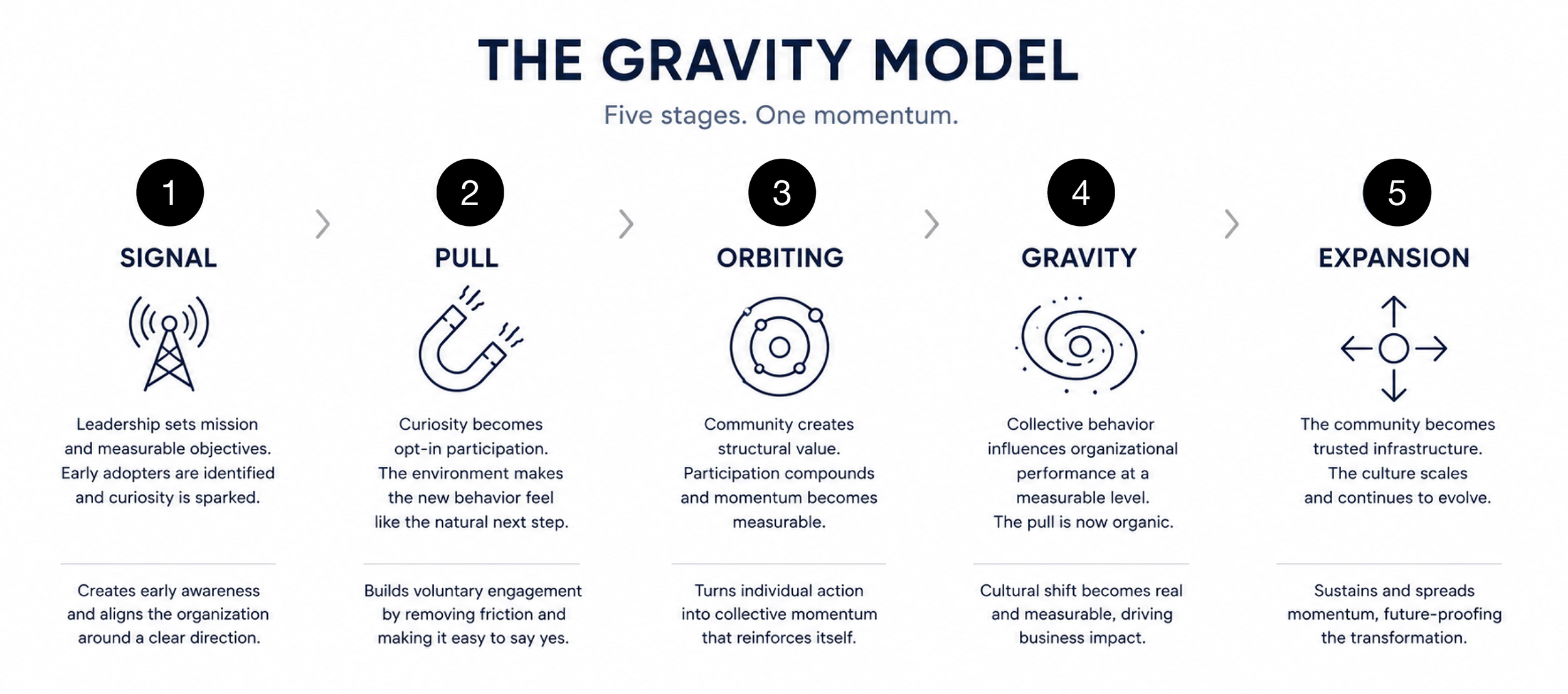
The Gravity Model provides a way of thinking about transformation through the lens of attraction rather than enforcement. Instead of asking how organizations can push people through change, it asks a different question: what conditions cause people to move toward new behaviors voluntarily?
This question becomes increasingly important as organizations navigate accelerating technological change. Across the research supporting this work, a consistent pattern emerges. Technology changes environments. Environments influence behavior. Behaviors shape culture. Culture ultimately determines whether transformation succeeds. The organizations that understand this chain are better positioned to adapt than those that focus exclusively on implementation.
People do not operate in isolation. They respond to incentives, observe peers, learn from trusted sources, and adapt to the systems around them. Over time, these influences create patterns of behavior that become cultural norms. Every organization develops its own form of gravity, a collection of forces that attract people toward certain actions, beliefs, and ways of working.
The challenge for leaders is not whether gravity exists. It always exists. The challenge is determining whether that gravity is pulling the organization toward the future or anchoring it to the past.
Why change is an environmental challenge
For decades, organizations have approached transformation as a communication challenge, a training challenge, or a project management challenge. While each of these elements matters, they often overlook a more fundamental reality: human behavior is heavily influenced by environmental conditions.
The systems people use, the incentives they experience, the relationships they form, the information they consume, and the expectations placed upon them all influence how they think and act. Change occurs when these conditions change.
This idea sits at the center of what we describe as Corporate Epigenetics. Just as environmental conditions influence how biological potential is expressed, organizational environments influence how human potential is expressed. Culture is not static. It evolves in response to the conditions surrounding it.
When organizations introduce new technologies, they are not simply deploying tools. They are altering the environment itself. New forms of intelligence, new workflows, new decision-making processes, and new patterns of collaboration create entirely new conditions for behavior to emerge.
The organizations that recognize this dynamic understand that successful transformation is less about forcing adoption and more about intentionally designing environments that support adaptation.
The cultural influence ladder
One of the assumptions behind the Gravity Model is that transformation rarely occurs all at once. People adopt new ideas, behaviors, and ways of working at different speeds and for different reasons.
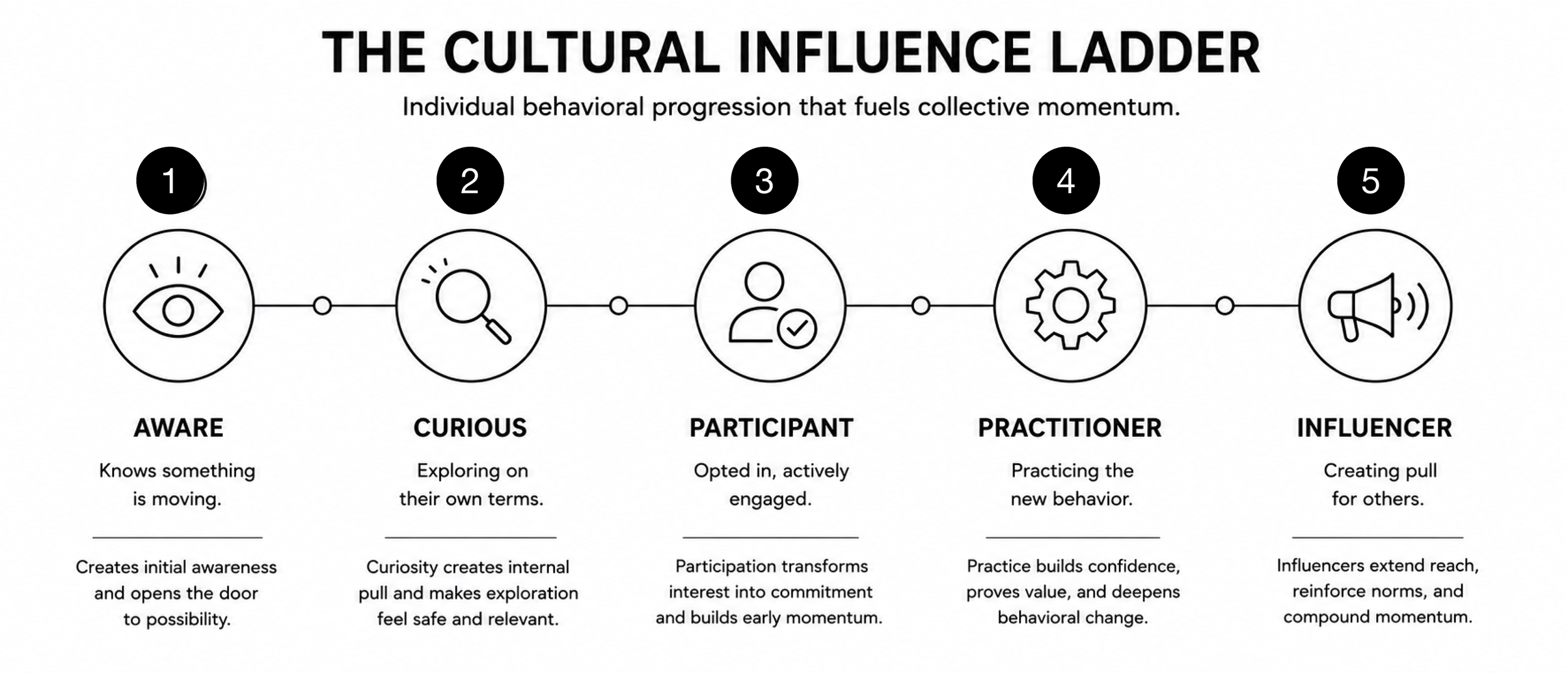
The Cultural Influence Ladder describes this progression. Individuals typically move through a series of stages, beginning with awareness, progressing through curiosity and participation, and eventually becoming practitioners and influencers. Each stage represents a deeper level of engagement with the change occurring around them.
This progression matters because organizational change is fundamentally a social process. Most people do not adopt new behaviors because they receive a communication or attend a training session. They adopt new behaviors because they observe others, see evidence of success, build confidence through experience, and gradually transfer trust from trusted sources to new practices.
This principle aligns closely with the concept of Trust Transfer. Individuals often borrow confidence from leaders, peers, subject matter experts, and communities before developing confidence of their own. As participation increases, influence begins to spread horizontally across the organization rather than exclusively from the top down.
The ladder also reflects the principle of Behavior Activation. Awareness alone rarely creates change. Lasting transformation occurs when people move from understanding to participation, from participation to practice, and eventually from practice to influence.
Over time, these individual transitions contribute to a larger phenomenon known as Collective Cognition. Knowledge, experience, and learning become distributed throughout the organization, allowing communities to adapt faster than any individual could alone. What begins as isolated experimentation gradually evolves into shared understanding, shared language, and ultimately shared culture.
The significance of the ladder is not that it categorizes people. Its value lies in helping leaders understand that transformation is less about persuading an entire organization simultaneously and more about creating conditions that allow influence to compound naturally over time.
When enough people move from awareness to participation and from participation to influence, cultural gravity begins to emerge.
From momentum to gravity
Most organizations can create temporary momentum. Far fewer can create sustained momentum.
Momentum often begins with leadership attention, excitement around a new initiative, or the introduction of a new capability. These forces can generate short-term energy, but they frequently fade once attention shifts elsewhere.
Gravity is different.
Gravity exists when behaviors become self-reinforcing. People participate because they see value. Communities form because participation creates value. Knowledge spreads because sharing creates value. The system begins producing its own momentum.
At this point, transformation is no longer dependent on constant intervention. Influence becomes distributed throughout the organization. Desired behaviors become socially reinforced. The environment itself begins encouraging the outcomes leaders originally hoped to achieve.
This is where Cultural Gravity emerges. The organization develops a natural pull toward specific behaviors and ways of working. Rather than pushing people toward change, the environment pulls them toward it.
The strongest organizations are not those that can create the most pressure. They are the ones that can create the most pull.
Intelligence changes the environment
The rise of artificial intelligence introduces one of the most significant environmental shifts organizations have experienced in decades.
AI changes access to information. It changes how decisions are made. It changes how expertise is distributed. It changes how teams collaborate. Most importantly, it changes how intelligence itself flows through the organization.
As intelligence becomes increasingly abundant, organizations are beginning to operate as ecosystems of distributed intelligence. Humans, agents, workflows, systems, and organizational knowledge interact continuously to create value. Success becomes less dependent on individual expertise and more dependent on how effectively intelligence is coordinated throughout the system.
This shift has profound implications for organizational adaptation.
In these emerging operating ecosystems, influence no longer flows exclusively through management hierarchies. Influence increasingly emerges through networks, communities, intelligent systems, and shared knowledge. The ability to create alignment, participation, and trust becomes even more important as organizations learn to coordinate across both human and machine contributors.
The future will not be shaped by technology alone. It will be shaped by the environments organizations create around that technology.
The future of change
The traditional language of change management often assumes that people resist change.
In reality, people frequently embrace change when they understand it, trust it, experience value from it, and see others benefiting from it. Resistance is often less a reflection of human nature and more a reflection of environmental design.
This distinction becomes increasingly important as organizations face continuous technological disruption. Future success will depend less on an organization's ability to execute individual transformation initiatives and more on its ability to continuously adapt.
Organizations that thrive will understand how environments influence behavior, how behavior shapes culture, and how culture ultimately determines performance. They will recognize that transformation is not an event but an ongoing process of adaptation.
Most importantly, they will understand that sustainable change is not created through pressure alone.
It is created through gravity.