


The cycle of influence
How organizations create momentum in the age of humanᴬᴵ
Technology does not transform organizations. People do.
Every successful transformation—whether driven by cloud computing, mobile devices, collaboration platforms, or artificial intelligence—ultimately succeeds or fails based on the behaviors of individuals. New tools can be deployed overnight, but new ways of thinking, working, and creating value emerge gradually through influence, experimentation, and adoption.¹ ² While organizations often focus their efforts on technology implementation, history repeatedly demonstrates that sustainable transformation occurs when people change how they work, learn, collaborate, and create value.
This observation sits at the center of the Devonport Cycle of Influence Model.
Originally developed as a practical framework for identifying influential individuals, coordinating organizational change, and measuring adoption over time, the model evolved as we observed transformation initiatives across increasingly complex technology environments. What began as a framework for understanding influence eventually became a framework for understanding transformation itself. The transition from Version 1 to Version 2 reflects this evolution, shifting the focus from individual stages of influence toward a continuous cycle that creates increasing organizational capability and impact.
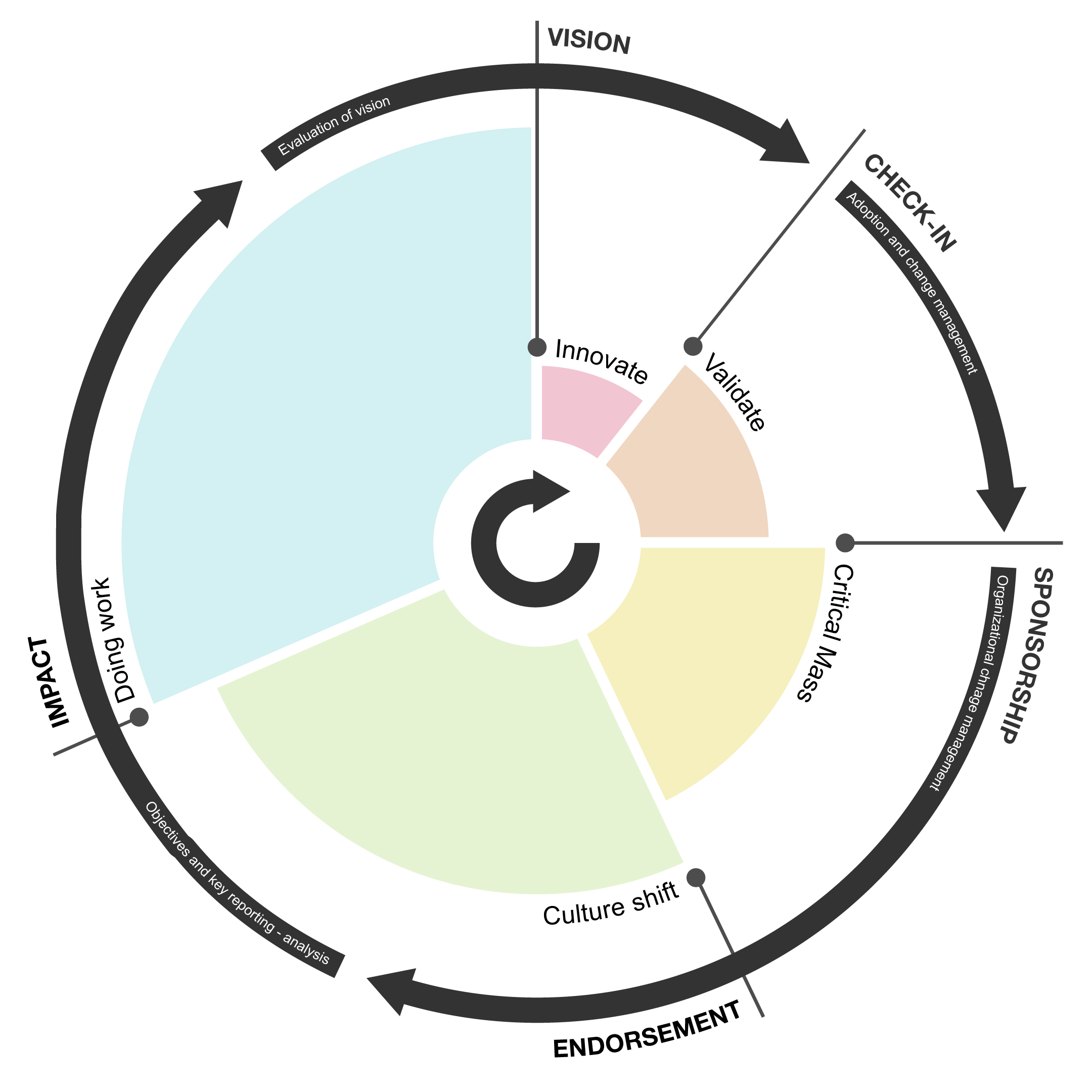
Figure 1:
Cycle of Influence
Evolution of the Cycle of Influence model
Figure 1. The evolution of the Cycle of Influence Model from a stage-based framework (Version 1) to a continuous transformation model (Version 2). The evolution reflects a shift from viewing influence as a project activity to viewing it as an ongoing organizational capability.
Today, the model serves two purposes. First, it helps organizations identify and activate the people most capable of accelerating change. Second, it provides a framework for understanding how work itself evolves as intelligence becomes increasingly abundant through AI and intelligent agents. This makes the model particularly relevant for organizations navigating Waves 1–3 of AI transformation, where the challenge is no longer access to technology but enabling people to evolve alongside it.
Why influence matters more than technology
One of the most consistent findings across decades of organizational research is that people rarely change because they are instructed to do so. They change when they observe trusted peers achieving meaningful outcomes.³ ⁴ New technology may create opportunity, but influence creates momentum.
This principle appears repeatedly throughout the Devonport research domains. Technology changes environments. Environments influence behavior. Behavior shapes culture. Culture ultimately determines whether transformation succeeds.⁵ ⁶ ⁷ The implication is significant. Organizations frequently measure success through deployment metrics, license activation, or training completion rates. Yet these indicators reveal very little about whether meaningful transformation is actually occurring.
A new AI assistant can be made available to every employee in an organization overnight. However, access alone does not create value. The more important question is how many people have fundamentally changed the way they work because of it. Have they adopted new workflows? Are they solving more complex problems? Are they spending more time creating value and less time managing routine tasks?
The Cycle of Influence Model was designed to answer these questions. Rather than viewing transformation as a communications challenge or a training exercise, it views transformation as a social system in which influence moves through networks of people, teams, and organizational relationships.⁸ This aligns closely with Devonport concepts such as Collective Cognition and Agent Ecology. Learning does not occur in isolation. It emerges through the interactions between people, knowledge, tools, systems, workflows, and increasingly, intelligent agents.
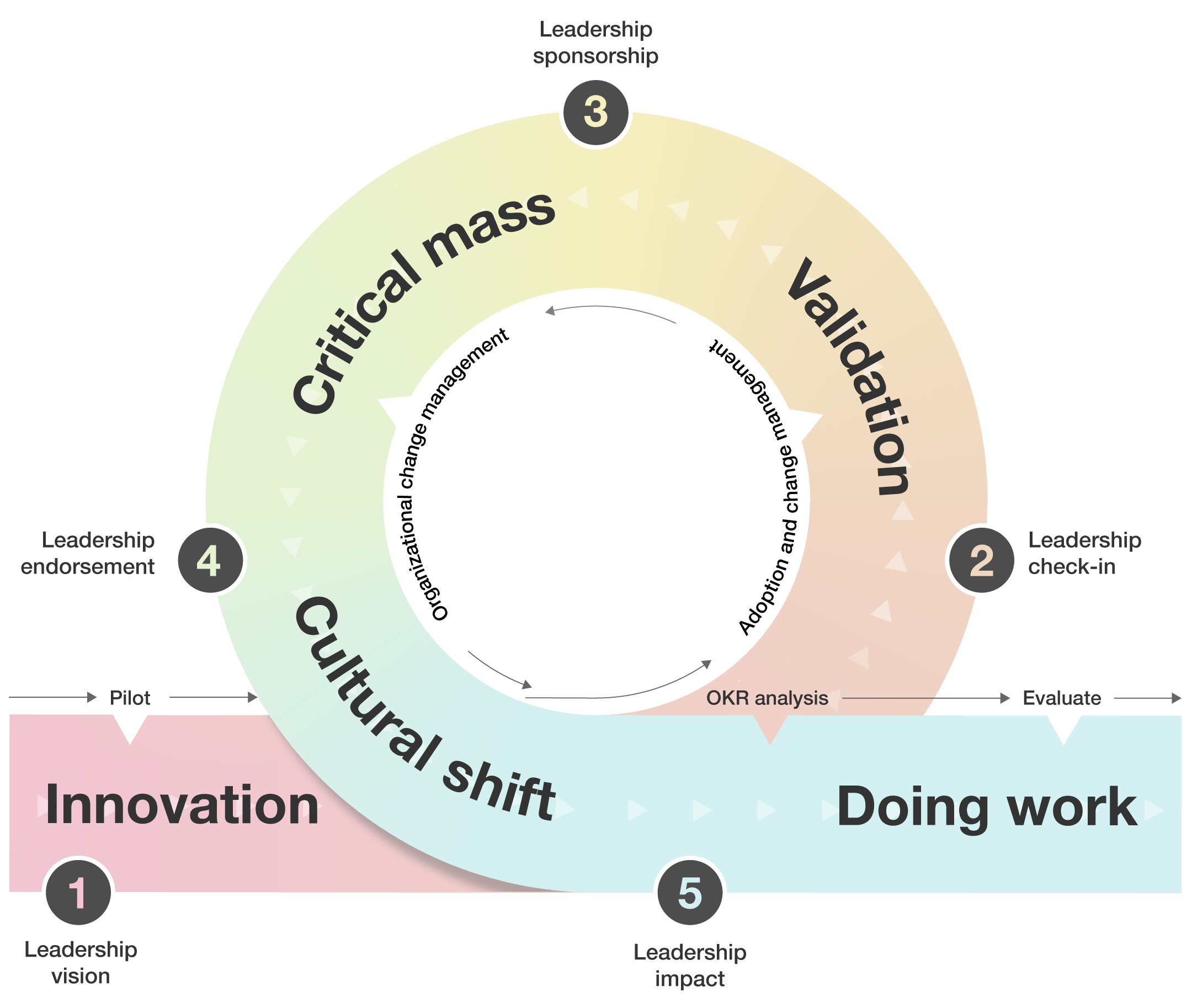
Figure 2. The Cycle of Influence model organizes transformation into five interconnected stages: Vision, Validation, Critical Mass, Cultural Shift, and Impact.
The Cycle of Influence model
While the framework appears cyclical, it should not be interpreted as a closed loop. Each rotation through the cycle increases organizational capability, expands adoption, and creates new opportunities for innovation. The five stages provide a practical structure for understanding how influence moves through an organization and how transformation gains momentum over time.
The five stages of influence
Every transformation begins with a vision. Leaders establish a desired future state, articulate why change matters, and define the opportunities they believe are possible. In the context of AI, these visions often focus on productivity, efficiency, automation, and optimization because these outcomes provide a practical and accessible starting point. Vision creates direction, but vision alone does not create transformation.
Transformation begins to accelerate during validation. Individuals experiment with new technologies, pilot new workflows, and demonstrate outcomes that others can observe. This is where influential individuals emerge. Their role is not simply to use the technology. Their role is to make possibility visible. By demonstrating practical success, they reduce uncertainty and create trust in the change process.³ Many of these individuals become what Devonport describes as Architects of the Edge—people capable of translating emerging technologies into practical organizational capability.
As successful examples multiply, organizations reach critical mass. Adoption begins spreading organically because participation becomes easier than resistance. Influence shifts away from leadership communication and toward peer validation. Employees increasingly trust the experiences of colleagues who have already adopted new ways of working.³ ⁴ Trust transfer begins to occur at scale, allowing momentum to build through social proof rather than organizational mandate.
Eventually these behaviors become normalized and a cultural shift begins to emerge. This stage aligns closely with Devonport's concept of Corporate Epigenetics. Just as environmental conditions influence biological expression, organizational environments influence cultural expression.⁵ ⁶ When AI becomes embedded into everyday work, it alters how people learn, collaborate, make decisions, and create value.⁹ ¹⁰ Over time these new behaviors become cultural expectations rather than optional activities.
The final stage focuses on impact. Organizations evaluate performance improvements, behavioral changes, capability development, and business outcomes. Importantly, the most meaningful transformations create value that was previously impossible. New products emerge. New services appear. New operating models become viable. Organizations discover opportunities they could not previously pursue because people now have the capacity and capability to invest in them.⁹ ¹¹ These outcomes ultimately inform the next vision and begin another cycle of transformation.
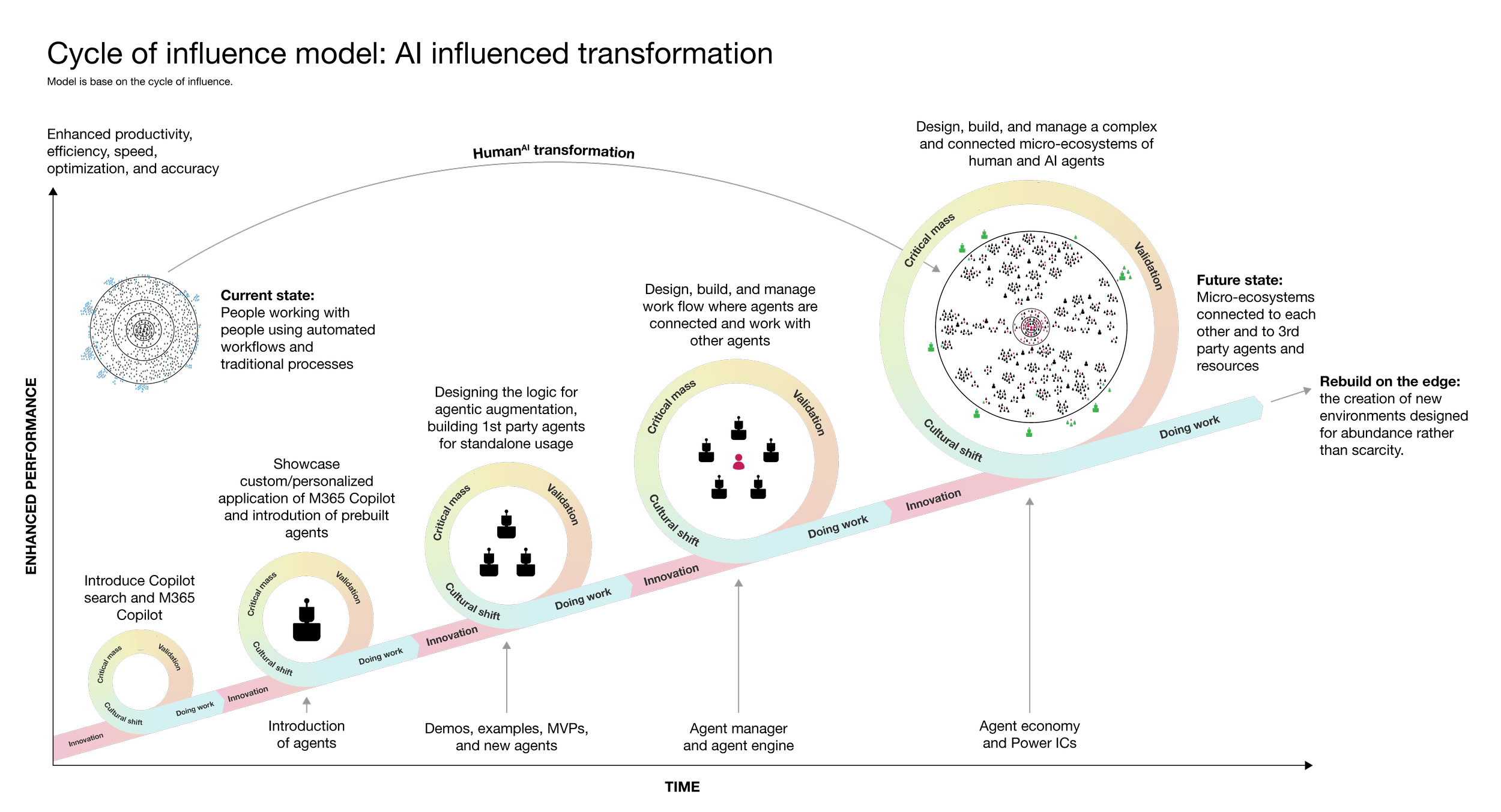
Figure 3. As organizations progress through Waves 1–3, each cycle builds upon previous gains, creating compounding improvements in capability, performance, and organizational maturity.
AI-Influenced Transformation
While the Cycle of Influence Model can be applied to any transformation initiative, artificial intelligence introduces a unique dynamic. Each cycle creates new capabilities, which in turn create opportunities for increasingly sophisticated forms of work. Rather than simply improving efficiency, repeated cycles of influence expand organizational capacity and unlock entirely new forms of value creation.
The evolution from adoption to augmentation
The model became particularly powerful when applied to AI transformation because it revealed something deeper than adoption patterns. It revealed how work itself changes.
Historically, organizations optimized employees around task execution. Individuals spent most of their time processing information, coordinating activities, managing workflows, and completing operational work.¹² Success was often measured through efficiency and throughput.
The introduction of AI changes this equation.
Initially, organizations experience modest gains through automation and assistance. Employees complete familiar tasks more efficiently and gain incremental productivity improvements.¹⁰ This represents much of what we see in Wave 1 and early Wave 2 adoption efforts.
As adoption expands, however, a more significant shift begins to occur. Employees gradually move from task execution toward oversight, orchestration, problem solving, creativity, judgment, and innovation.¹² ¹³ Rather than simply performing work, they increasingly coordinate work across systems, agents, and teams.
This progression reflects a core Devonport principle: the function of technology is not simply to automate work. It is to elevate the human condition.
The objective is not fewer humans, it’s more capable humans.
Humanᴬᴵ and the changing role of the individual
As intelligent agents become increasingly capable, organizations face an important question: if agents perform more tasks, what becomes the role of the human?
The answer can be found in the Humanᴬᴵ framework.
Humanᴬᴵ describes the multiplication of human capability through intelligent systems. Rather than replacing human contribution, AI expands the scope of what individuals can accomplish.¹² ¹³ As this occurs, the nature of work shifts from execution toward coordination. Employees become designers of workflows, orchestrators of agents, curators of knowledge, decision-makers, innovators, and stewards of organizational culture.
The most valuable individuals increasingly become those capable of coordinating ecosystems of distributed intelligence rather than simply executing individual tasks.¹⁴ ¹⁵ They understand how to combine human judgment, organizational knowledge, AI capability, and agentic workflows to generate outcomes that none of those components could create independently.
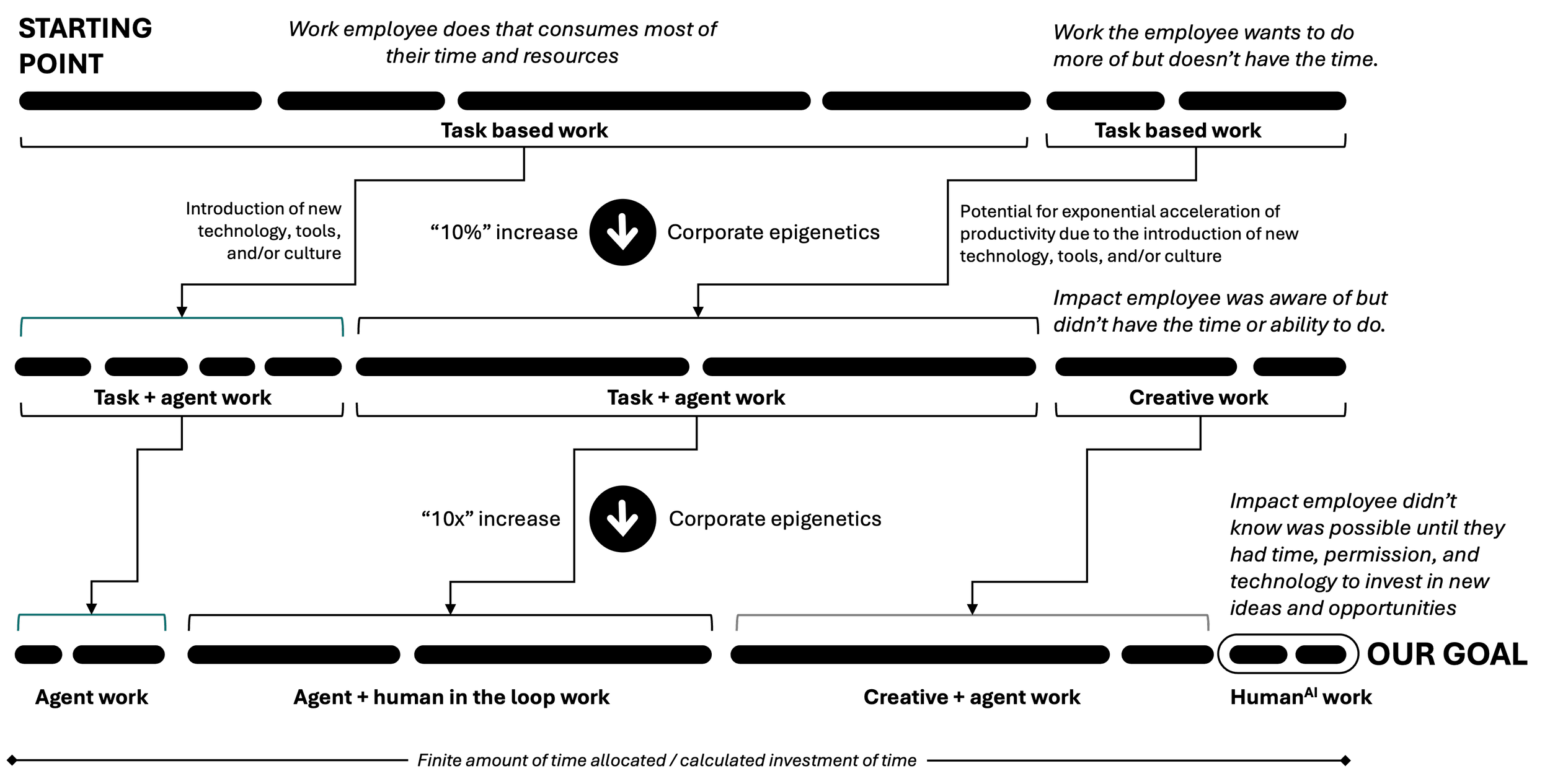
Figure 4. The evolution of the individual contributor from task execution toward Humanᴬᴵ work, where humans and intelligent agents collaborate to create new forms of value.
Workplace Evolution of the individual contributor
As agents assume more routine work, individuals gain the capacity to invest more time in creativity, judgment, experimentation, innovation, and opportunity creation. In many cases, employees discover opportunities they were previously aware of but lacked the time or resources to pursue. In other cases, they uncover entirely new possibilities that only became visible once technology expanded their available capacity.
The cycle creates performance compounding
The true power of the Cycle of Influence Model emerges when it is viewed across multiple iterations rather than a single transformation initiative. Each pass through the cycle increases organizational familiarity with change, expands internal capability, strengthens networks of influence, and improves the organization's ability to coordinate intelligence across people and systems.
This creates what Devonport describes as Performance Compounding. Early cycles focus primarily on adoption and productivity. Later cycles increasingly focus on capability creation, innovation, and new forms of organizational value. Employees develop new skills, leaders gain confidence in emerging technologies, and organizations become more capable of adapting to future change.¹¹ ¹⁴
The result is not simply improved performance. The result is increasing adaptation velocity. Organizations become better at learning, experimenting, and evolving. They build the foundations required to operate within ecosystems of distributed intelligence where humans and agents collaborate to solve increasingly complex problems.⁷ ¹⁴ ¹⁵
This progression represents the journey through Waves 1–3. More importantly, it lays the foundation for what comes next.
Why this matters for organizational leaders
Most organizations currently focus on technology adoption. Far fewer focus on influence architecture.
Yet the organizations achieving the greatest results are often those that intentionally cultivate networks of champions, innovators, and trusted practitioners who accelerate organizational learning and capability development. They understand that transformation is fundamentally a human challenge rather than a technology challenge.
The Cycle of Influence Model provides a framework for doing exactly that. It helps leaders identify where transformation is succeeding, where momentum is stalling, and which individuals are creating the greatest influence across the organization. More importantly, it shifts the conversation away from deployment metrics and toward capability development.
The future will not be determined by which organizations have access to AI. Intelligence is rapidly becoming abundant. The future will be determined by which organizations can most effectively coordinate human potential, organizational knowledge, and intelligent systems into functioning ecosystems of distributed intelligence.¹⁴ ¹⁵
Conclusion
The Cycle of Influence Model began as a framework for managing adoption. It evolved into a framework for understanding transformation.
Across Waves 1–3, organizations introduce new technologies, validate new behaviors, build critical mass, create cultural change, and measure impact. Each cycle expands organizational capability and prepares the environment for the next stage of evolution.
What makes the model particularly relevant today is that it provides a bridge between traditional change management and the emerging Humanᴬᴵ future. It recognizes that transformation is not fundamentally a technology problem. It is an influence problem.
Technology changes environments. Environments shape behavior. Behavior shapes culture. Culture determines outcomes.
The organizations that thrive will be those that intentionally design these cycles, cultivate influential individuals, and help people evolve alongside the intelligent systems they create. Because in the age of abundant intelligence, the most important capability is no longer technology adoption.
It is the ability to continuously elevate people potential.
References
1. Kotter, J. P. (2012). Leading Change. Harvard Business Review Press.
2. Rogers, E. M. (2003). Diffusion of Innovations (5th ed.). Free Press.
3. Rogers, E. M. (2003). Diffusion of Innovations (5th ed.). Free Press.
4. Cialdini, R. B. (2021). Influence: The Psychology of Persuasion (Revised Edition). Harper Business.
5. Lewin, K. (1947). Frontiers in Group Dynamics. Human Relations, 1(1), 5–41.
6. Schein, E. H. (2010). Organizational Culture and Leadership (4th ed.). Jossey-Bass.
7. Senge, P. M. (2006). The Fifth Discipline: The Art and Practice of the Learning Organization. Doubleday.
8. Castells, M. (2010). The Rise of the Network Society (2nd ed.). Wiley-Blackwell.
9. Davenport, T. H., & Ronanki, R. (2018). Artificial Intelligence for the Real World. Harvard Business Review.
10. Brynjolfsson, E., Li, D., & Raymond, L. R. (2023). Generative AI at Work. National Bureau of Economic Research.
11. Westerman, G., Bonnet, D., & McAfee, A. (2014). Leading Digital. Harvard Business Review Press.
12. Autor, D. H. (2015). Why Are There Still So Many Jobs? The History and Future of Workplace Automation. Journal of Economic Perspectives, 29(3), 3–30.
13. Mollick, E. (2024). Co-Intelligence: Living and Working with AI. Portfolio.
14. Malone, T. W. (2018). Superminds: The Surprising Power of People and Computers Thinking Together. Little, Brown Spark.
15. Woolley, A. W., Aggarwal, I., & Malone, T. W. (2015). Collective Intelligence and Group Performance. Current Directions in Psychological Science, 24(6), 420–424.
Devonport concepts referenced
Humanᴬᴵ, Collective Cognition, Agent Ecology, Corporate Epigenetics, Architects of the Edge, Ecosystems of Distributed Intelligence, Performance Compounding, Adaptation Velocity, Trust Transfer, and People Potential are Devonport concepts developed through the Devonport Manifesto, Lexicon, and Domain Research Series.